
Physics - Motion 16 (Intro to Projectile Motion)
OPENING QUESTION:

a) What is the ratio of the base of the triangle to the hypotenuse of the triangle? Please show all work.
b) What is the ratio of the height of the triangle to the hypotenuse of the triangle? Please show all work.
c) What is the ratio of the base of the triangle to the height of the triangle? Please show all work.
LEARNING OBJECTIVES:
I will review trig basics during today's classCALENDAR:
WORDS O' THE DAY:
- Projectile Motion - Up/Vertical (y motion) AND Out/Horizontal (x motion)
FORMULAE OBJECTUS:
1a) vfx = vix +axt
1a) vfy = viy +agt
2a) xf = xi + vit + 1/2at2
2b) yf = yi + vit + 1/2agt2
3a) vf2 - vi2 = 2a∆x
3b) vf2 - vi2 = 2ag∆y
WORK O' THE DAY:
Let's review our opening diagram triangle, but before we do that, let's solve for the length of side "a' below.
Did you remember sig figs?
Did you remember units?
 |
1) Notice the Greek character θ (theta). 2) We will *always* refer to the sides of a triangle in context to one of the two angles that are NOT the right angle. Let's revisit our opener but this time find those ratios by their relationship to the angle theta shown (be sure to use the value you calculated for side a): a) What is the ratio of the side of the triangle opposite θ to the hypotenuse? (defined as sine) b) What is the ratio of the side of the triangle adjacent to θ to the hypotenuse? (defined as cosine) c) What is the ratio of the side of the triangle opposite θ to the size adjacent ? (defined as tangent)
|
 |
2) a) What is the ratio of the side of the triangle opposite θ to the hypotenuse? (defined as sine) b) What is the ratio of the side of the triangle adjacent to θ to the hypotenuse? (defined as cosine) c) What is the ratio of the side of the triangle opposite θ to the size adjacent ? (defined as tangent) |
Notice how *perfectly* trig works with vectors!
Since vectors make up a *HUGE* part of vectors, trig becomes an essential tool for working with vectors.
Let's do just a wee bit of drilling HERE
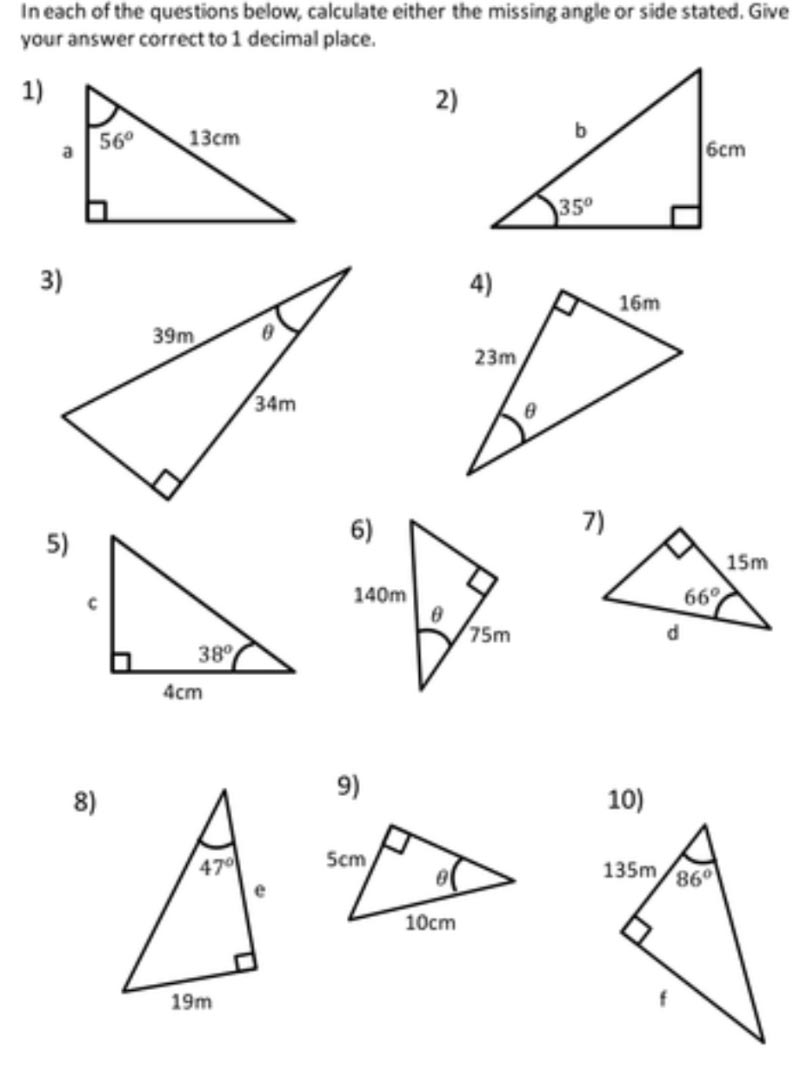
Now let's get to the really good stuff.
Let's say that you're out with your good ol' wrist rocket and (what else?) your ever-present supply of frozen grapes!!!
You launch a grape with an initial velocity of 41 m/s at an angle of 45 degrees to the horizontal.
How can you use the definition of sine and cosine to *quickly* find the vix? and viy?
Please sketch that situation now.
- Please work with your team to determine how high that grape goes.
- Now please determine how long the grape is in the air.
- Now please determine how far away from the grape lands.